AI agents need a new access-control layer.
Agents now act inside companies with real credentials: they read customer records, call internal APIs and change systems. AgentFort is the layer that lets security teams approve that work. Every agent is identified, limited to the access its job needs, kept away from sensitive data, contained if it is manipulated, and recorded.
Agents are becoming operators. Access control has not caught up.
Enterprises can't hand agents broad credentials.
Agents inherit the access of the people and services they run as, so one assistant can reach far more than its job needs. Security teams either block production use or approve it without evidence.
Agents are moving into real work.
They are moving from chat into APIs, browsers, SaaS tools, code and sensitive workflows faster than existing security controls were designed to govern.
Start where the risk is highest.
Coding agents, browser agents, internal copilots, customer-support agents and regulated-data workflows, where security has to sign off before agents reach production.
Five controls, one platform, each already built.
Each control answers a question a security team asks before it lets an agent into production. Enforcement runs on the customer's side, in their cloud or network.
-
01
Identity
Which agents are running, and who answers for each?
Finds the agents already running across endpoints, clusters, cloud accounts and telemetry, with no per-agent registration, and gives each one a verified identity and an accountable owner.
-
02
Access
What may this agent do, right now?
Plain-language policy compiled into rules you can review and test before release, checked on every request next to your services. Authority is delegated within ceilings and expires.
-
03
Data protection
What sensitive data is leaving through agents?
Inspects prompts, files and tool results; classifies personal data, payment data and secrets; masks or blocks them before they leave.
-
04
Isolation
What happens when an agent is manipulated?
Each task runs in its own sandbox with no direct network path and no credentials inside. Sensitive actions wait for a person to approve the exact action.
-
05
Visibility
What did every agent do, and why was it allowed?
A live inventory of agents, owners and systems, and a receipt for every request: identity, owner grant, policy and outcome, kept on your side.
Watch the product
Recorded from the working product in a lab environment.
 Finding every agent
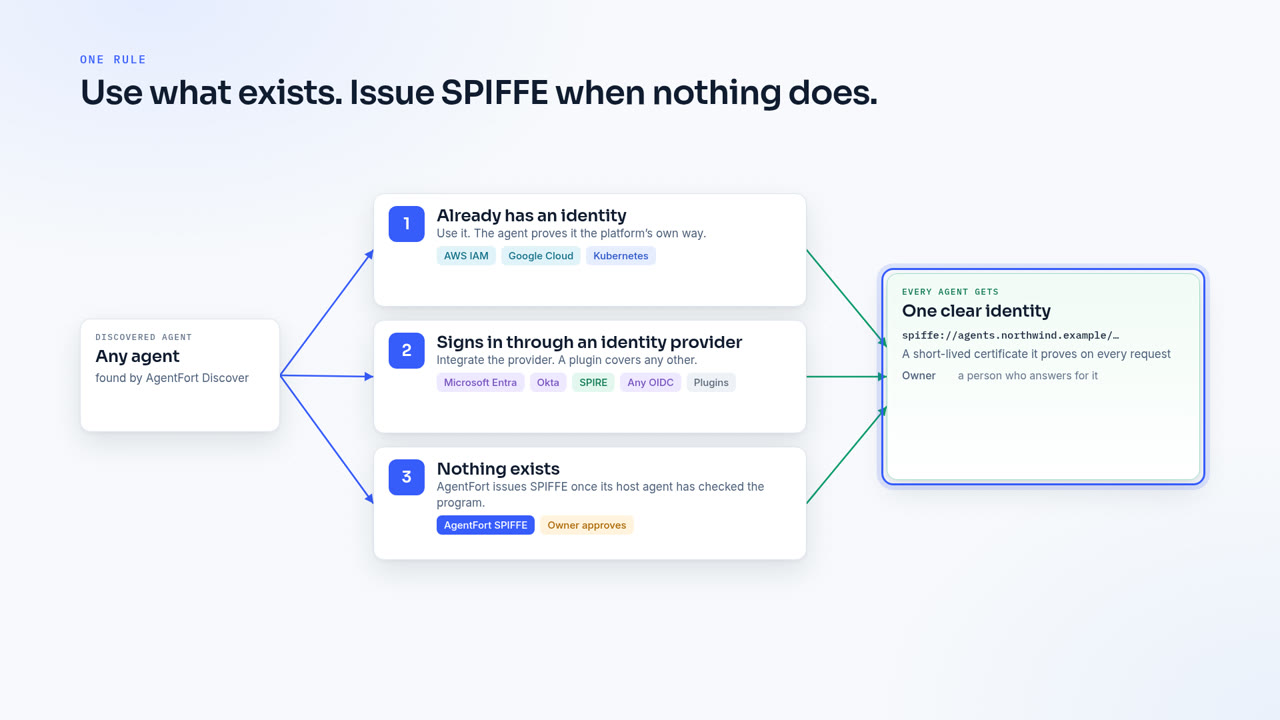 An identity for every agent
 Least-privilege access
 Keeping data safe
 Containing a manipulated agent
Built and running end to end. Now open to enterprise design partners.
All five controls run end to end today, as the recorded demos show. Design partner deployments start with each enterprise's highest-risk agents and extend across its agent estate.
Built security automation at Amazon. Now building it for agents.

Raghuveer K
Founder, AgentFort · previously Lead, Security Automation at Amazon
12 years founding, building and leading security automation, application security, identity and payments work inside Amazon.
- Founded, built and led security automation products and teams inside Amazon across application security, identity, payments and enterprise-scale systems.
- Created Design Inspector and Deep Threat Modeler, which turn architecture, code, data-flow and dependency signals into security reasoning.
- Worked directly on access boundaries, least privilege, service-to-service authentication, regulated data and production security review.
- Master's degree in Artificial Intelligence; named inventor on five issued patents in security automation and design analysis.
Issued patents
| Patent | Title |
|---|---|
| US 12,174,963 | Automated selection of secure design patterns |
| US 12,019,742 | Automated threat modeling using application relationships |
| US 11,531,763 | Automated code generation using analysis of design diagrams |
| US 11,507,655 | Automatic and predictive source code generation |
| US 10,860,295 | Automated detection of ambiguities in software design diagrams |
Talk with the founder.
- Category thesis: why AI agents need a new access-control layer.
- Product: the five controls, what is built and where it expands.
- Founder-market fit: security, identity and automation background.
- Next steps for design partners and investors.